

Tim Done Slop
Tim Dunlop's AI-generated defamation
On 27 April, author, journalist, and academic Tim Dunlop used AI to write an article titled Grief and political clarity can coexist. The article is a criticism of my 1 January Newsletter titled We don’t mourn fascists.
In a Substack note promoting the article, Dunlop wrote: ‘An Australian artist is paying a heavy price for his political views, but what did he actually say?’
The opening paragraph of Dunlop’s article identifies We don’t mourn fascists as having led to the erasure of my work from ‘classrooms, libraries and bookshops’. And so, his article continues: ‘I thought I’d take a closer look at what Chun wrote’.
We now know that Dunlop did not, in fact, take a closer look. Included in Dunlop’s AI-generated concoction is an entirely false paragraph attributed to me as a ‘quote’. This false ‘quote’ is the centrepiece of Dunlop’s article, and is fundamental to his criticism of me. It is also objective nonsense, and bears no relationship or similarity to anything I have ever written.
In particular, Dunlop’s AI text fabricates a dismissive comment falsely attributed to me about ‘a dead child’. Nothing of the sort has been written by me in my Newsletter or elsewhere. Nevertheless, this ‘quote’ is presented as the moment where, according to Dunlop’s article, I go ‘badly off track’. It’s the basis from which Dunlop develops a number of defamatory imputations, and invites his readership to regard me as ‘frankly, grotesque’ and ‘vile’.
I became aware of Dunlop’s article on 26 May, a month after its publication, when I saw it being shared credulously on Instagram by a member of the children’s publishing industry. I wasn’t familiar with Dunlop, but quickly learned that he is a successful writer; a journalist for national mastheads, a published author, and a ‘sought-after’ public speaker with a PhD in political philosophy and communication. On Substack, Dunlop maintains a large audience including hundreds of paid subscribers. At the time, Dunlop was ‘#45 rising in world politics’ on this platform.
As soon as I read the article, I contacted Dunlop. Despite offering me ‘apologies for the error’, Dunlop stated that he would be too busy to do anything about it for ‘a few days’. When I requested greater urgency, he added a ‘correction’, but did not remove the article.
Dunlop also lied to me, stating that the false and defamatory article had originated in an ‘email discussion with people I know and generally trust’. I pushed back on this assertion, asking Dunlop to tell me more about these supposed ‘people’. A day later, unable to substantiate his lie, he admitted to having ‘written’ his article using AI.
On 29 May, Dunlop finally deleted the article and posted a public apology. While I appreciate its eventual removal, Dunlop’s AI-generated defamation was public for 30 days, during which time it enjoyed wide engagement and shares. It drew a significant number of comments by admiring readers who found Dunlop’s misinformation convincing. For example, one commenter praised Dunlop for his ‘clear-sighted and thoroughly informed’ opinion about me. The article also remains intact and uncorrected in the inboxes of his many subscribers. Also, it is currently still searchable in internet archives; it remains a part of the machine.
It should also be noted that Dunlop’s article entered and informed the public conversation during a surge of Zionist-led repudiations of my creative practice, including cancellations, removals, and the destruction of my work. At the time, a large number of people were already forming and sharing strong opinions about We don’t mourn fascists — while admitting not to have read it. In this context, defamatory misattributions such as Dunlop’s were, at best, exacerbatory.
At the time of Dunlop’s article, University of Queensland was struggling to establish a legal basis for its purported termination of its publishing agreement with me. I think it’s also relevant to note that the false statements and defamatory imputations advanced by Dunlop were entirely convenient to the university’s position.
The full extent of the damage caused by an article like Dunlop’s can never be quantified. So what have been the consequences for Dunlop? Since issuing his apology and retraction, Dunlop has continued to ‘write’ articles for his large audience. His Substack still bears an ‘orange tick’ indicating that hundreds of people continue to pay for his ‘writing’. He continues, it seems, to enjoy a career as an ‘author’ and academic. On the website of the abovementioned University of Queensland, for example, Dr Dunlop is touted1 as an academic ‘interested in online technologies as agents of social change’ and as the author of ‘a seminal text on the changes wrought to journalism by digitisation’. I shit you not.
In weaponising AI to manifest a hit piece, Dunlop is not exceptional. On 2 April 2025, for example, Helyeh Doutaghi, an Iranian scholar, announced that she had been terminated from Yale Law School based solely on AI-fabricated allegations from a Zionist platform calling itself ‘Jewish Onliner’.
Doutaghi wrote:
Rather than investigate the source of these allegations first, the nation’s ‘top law school’ accepted them at face value, and shifted the burden of proof from the accuser to the accused, treating me, prima facie, as guilty until proven otherwise. Whether Yale Law School’s attorneys knowingly relied on AI-fabricated claims or simply chose wilful ignorance remains unanswered.
Following her termination, Doutaghi wrote:
Do we acquiesce to the repression imposed by a genocidal Western order or do we join the majority world of the Global South, led by the Palestinians fighting against the Zionist death machine, in continuing to raise costs & end impunity granted to those waging genocidal war?
The violence of AI, of course, extends far beyond its ability to hallucinate defamatory misattributions for the benefit of Zionist operatives and lazy grifters. If we consider ourselves as being on the ‘left’, we must reject AI with the same uncompromising diligence that we apply to Zionism and US imperialism. We should absolutely never use AI in our political organising, recreationally, or to develop, generate, review, or refine our texts and images.
When we use AI, we directly reinforce corporate and colonial dominance, exacerbate inequality, and accelerate environmental collapse. When we use AI, we directly exploit human artists and writers. AI imagery is not ‘inspired’ by its source material; that material is stolen. When we use AI, we support the very companies — and help train the very technology — that imperialist forces are using to surveil, target, oppress, and mass-murder in places like Palestine. When we use AI, we help build a post-truth future that can only benefit the ruling class.
Zionists, of course, regularly use AI to generate images of their heroism, military achievements, victimhood, and popular support, because these things simply don’t exist for them in reality.

Revolutionary movements, by contrast, are grounded in truth, lived experience, human dignity, and materiality. They don’t require false texts, faked images, stolen art, and non-human hallucinations.
Long-time readers of my Newsletter will already be aware that I’ve never used AI in my writing. In fact, I always footnote my articles with the following personal policy:
I never use AI to generate, edit, or refine any part of my image-making, research, writing, or publishing process. When I make art, I use traditional materials: pencil, watercolour, and ink on paper. If you consume my work you can be sure that the labour, creativity, language, and materiality is my own.
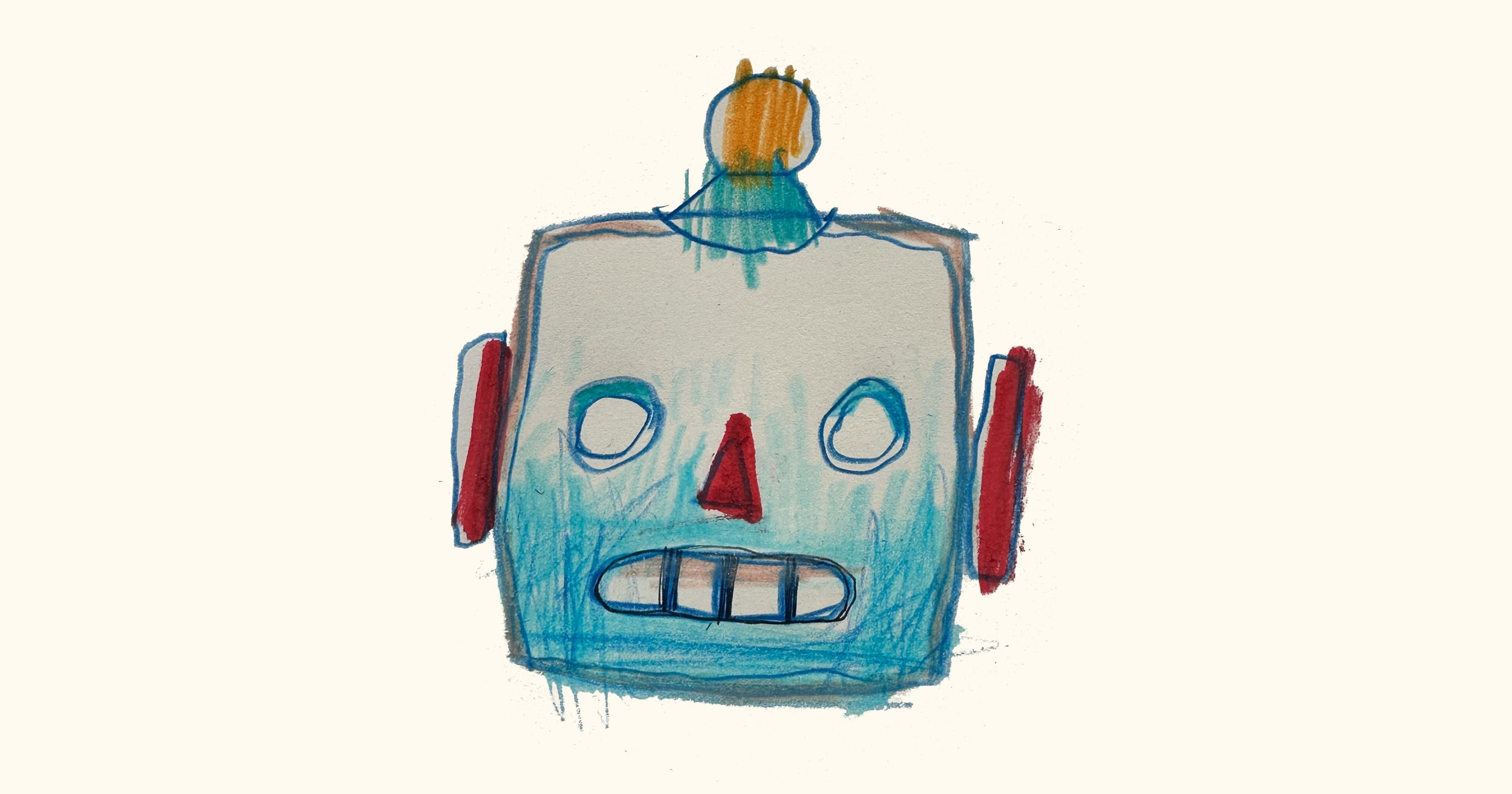
Image: messy pencil and texta drawing on paper, doodled while writing this article.
Legal note: On 1 June, I sent Tim Dunlop a concerns notice for the purposes of the Defamation Act 2005 (Vic). I reserve all rights in relation to the matter. Nothing in this Newsletter should be regarded as an acceptance of Dunlop’s apology, nor exhaustive of the matters upon which I may rely in any future proceedings. I reserve the right to rely upon additional evidence as it becomes available.
Thanks for reading Matt Chun’s Newsletter.
I’m an independent artist, writer, and picture book creator. To support my practice, visit my online store or consider becoming a paid subscriber to this newsletter.
I’m also a founding and current co-editor of revolutionary print periodical The Sunday Paper, an imprint of Slingshot Books.
To share information with me about censorship, ownership, funding, infiltration, or influence, please use my secure submission form. I’m happy to archive receipts from any industry or community. However, I’m more likely to follow up and write about a subject that falls within my areas of experience: primarily visual arts, the Australian publishing industry, and news media in the Australian colony.
AI policy: I never use AI to generate, edit, or refine any part of my image-making, research, writing, or publishing process. When I make art, I use traditional materials: pencil, watercolour, and ink on paper. If you consume my work you can be sure that the labour, creativity, language, and materiality is my own.
Update: after publication of this article, University of Queensland removed this page. However, I screenshot everything:

I am so sorry to read this and to also know of what you and your collaborator have been through. I also refuse to use AI in any of my work, and I will never, ever use it in my art or writing or any other job I have. What you have articulated aligns with my own understandings of what I would enable through its use. So many think it is benign and 'useful', as we use it is scrapes and builds momentum, and yes, empowers many of the evils of the world.
Thanks for bringing my attention to sloppy Dunlop, he and many other 'writers' and 'scholars' claim to be critiquing the use of AI when they are clearly on the gravy train, 'just bend over' seems to be their collective genius in this area. Power to you. Peace and love.
The Dunlop post has not been totally deleted from the internet. This morning I was able to access a version from 27/4/2026 that commences with a different version of the "apology" that starts "In egregious error on my part I attributed a quote to Matt Chun that are not his words and I apologize unreservesly for this error. It arose from using an LLM (AI) to search for related material...".
This "apology" is then followed by the entire Dunlop article with paragraphs affected by the error simply crossed out (but still readable)
This version of the "apology" is dated 27/4/2026
I accessed this via my iPhone which in URL for article includes ute_media-ios. When I pasted this into my computer, the article did not display (said it was not available) so it appears that the article is probably still available for users with iphones or possible other types of media